
The short answer:
- After every cook: brush the grates while they're warm and check the drip tray.
- Every month (if you grill weekly): empty and wipe the grease tray, wipe down the exterior, and check that your flames burn mostly blue.
- Once a year: a full professional deep cleaning. Twice a year if you grill more than about four times a week year-round.
A clean grill isn't just about looks. It's what makes cooking safe, keeps the flavor right, and protects an outdoor kitchen that may have cost thousands of dollars. This is the schedule we give our own customers.
Why the desert changes the math
Grills in the Coachella Valley work harder than grills in most of the country, and they sit outside in tougher conditions:
- A long cooking season. With mild winters, many households grill year-round, and every cook adds grease and carbon.
- Summer heat bakes buildup on. Grease left sitting through triple-digit afternoons hardens into carbon that a brush can't touch.
- Wind and dust. Blowing sand and dust stick to greasy surfaces and work their way into burners and hinges.
- Grills that sit idle. If you're away for the summer, a grill with old grease inside is an open invitation to insects and rodents. Spiders and insects can also nest in burner tubes and block the gas flow.
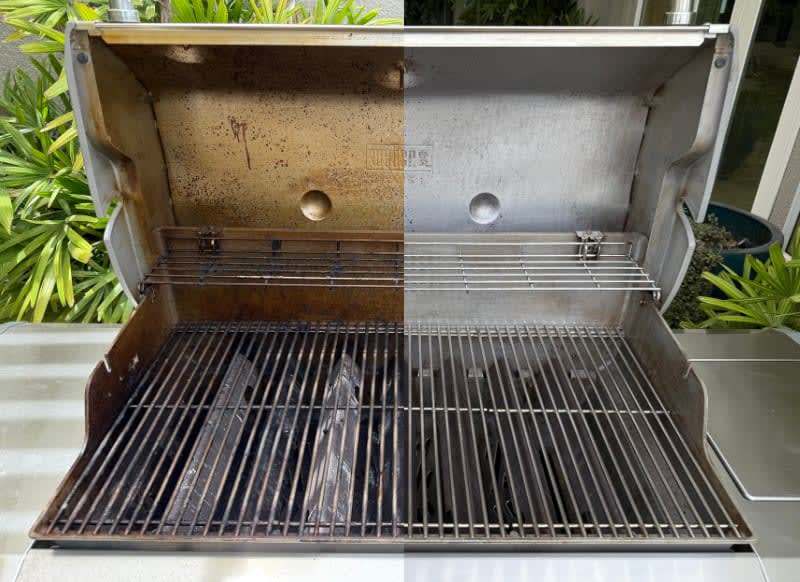
Signs your grill is overdue for a deep clean
- Flare-ups every time you cook, even with lean food
- Hot spots and cold zones: food charred on one side of the grill and raw on the other
- Lazy yellow flames instead of crisp blue ones
- Smoke and a rancid smell while preheating an empty grill
- Black flakes landing on your food
- The igniter clicks but the burner won't light
- Rust flakes in the firebox or on the heat shields
If you're checking two or more of those, a brush and a hose won't fix it. The buildup lives under the grates, on the heat shields and flavorizer bars, inside the burner ports and in the firebox.
5 habits that keep a grill in top shape between cleanings
1. Clean the grates after every use
Brush the grates while they're still warm, when residue comes off easily, then wipe the surfaces with a mild degreaser. After using any wire brush, check the grates for loose bristles before you cook. Bristles that end up in food can cause real injuries.
2. Empty the drip pan regularly
A full drip pan is a fire hazard and a magnet for pests. Make it a habit to check and empty it after every cookout.
3. Deep clean at least once a year
Even with good habits, carbon and grease build up in places you can't reach without taking the grill apart. Schedule a deep cleaning at least once a year, and twice if you grill more than about four times a week year-round.
4. Check for gas leaks
Brush a soap-and-water solution on the hose and connections with the gas on and the burners off. Growing bubbles mean a leak. Turn off the gas and don't use the grill until it's fixed.
5. Protect the grill from the elements
A good cover keeps out sun, dust and debris and can add years to a grill's life. Just make sure the grill has cooled completely before you cover it.
Clean grill, better food
Old grease goes rancid, and it transfers straight onto whatever you're cooking. Clogged burners create hot and cold zones that no amount of technique can fix. Built-up grease causes flare-ups that scorch food instead of searing it. After a deep clean, you taste the food and not last season's leftovers, and the grill heats evenly across the whole surface.
Want us to handle the deep clean?
Our professional grill cleaning includes full disassembly, a heated soak tank for the grates and heat shields, steam cleaning, burner and igniter care, and a stainless polish. Booked online, it's $250 for a standard cleaning and $350 for larger or heavily used grills. We come to you anywhere in the Coachella Valley.